

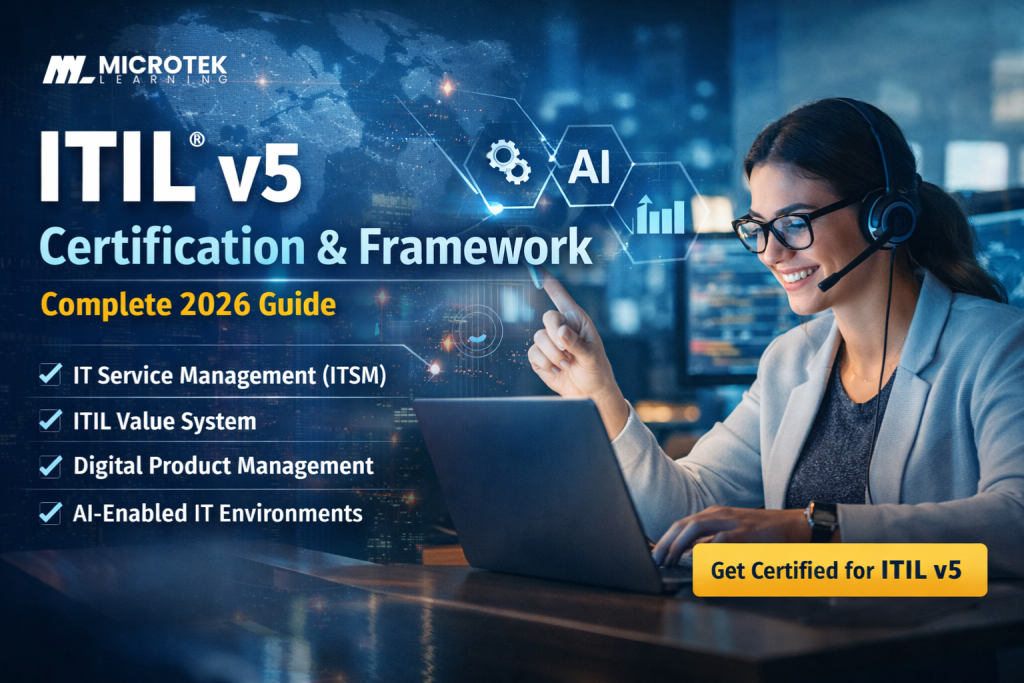
The world of IT service management is evolving rapidly. Organizations today are managing complex digital ecosystems, AI-driven operations, and customer-centric digital services. To address these modern challenges, the ITIL framework continues to evolve.
The ITIL v5 certification is expected to represent the next stage in the evolution of IT Service Management (ITSM), building upon the foundation laid by previous versions while aligning IT operations with modern digital transformation strategies.
For IT professionals, service managers, and organizations seeking structured service management practices, understanding the ITIL v5 framework and certification pathway is essential.
This guide covers everything you need to know about ITIL v5 certification, including the framework, potential certification structure, benefits, career opportunities, and how to prepare for training.
Table of Contents
What Is ITIL v5?
ITIL (Information Technology Infrastructure Library) is a globally recognized framework designed to help organizations manage IT services efficiently and align them with business objectives.
The upcoming ITIL v5 framework is expected to expand the principles of IT Service Management (ITSM) to better support modern digital organizations. While earlier versions focused primarily on IT service operations, ITIL v5 moves further toward managing digital products, services, and customer experiences.
The framework is expected to incorporate:
- AI-driven service operations
- Advanced automation practices
- Digital Product Management integration
- Experience-driven service design
- Data-driven service optimization
In short, ITIL v5 aims to help organizations deliver value through services in AI-enabled IT environments and rapidly evolving digital ecosystems.
Evolution of ITIL: From ITIL v3 to ITIL v5
Understanding the evolution of ITIL helps explain why the ITIL v5 certification is becoming increasingly relevant.
| Version | Focus | Key Highlights |
|---|---|---|
| ITIL v3 | Service Lifecycle | Structured lifecycle approach to IT services |
| ITIL 4 | Service Value System | Focus on value co-creation and agile practices |
| ITIL v5 | Digital Service Ecosystems | Integration with AI, automation, and product-based IT |
The shift toward digital product and service management reflects how organizations now operate in a technology-driven economy.
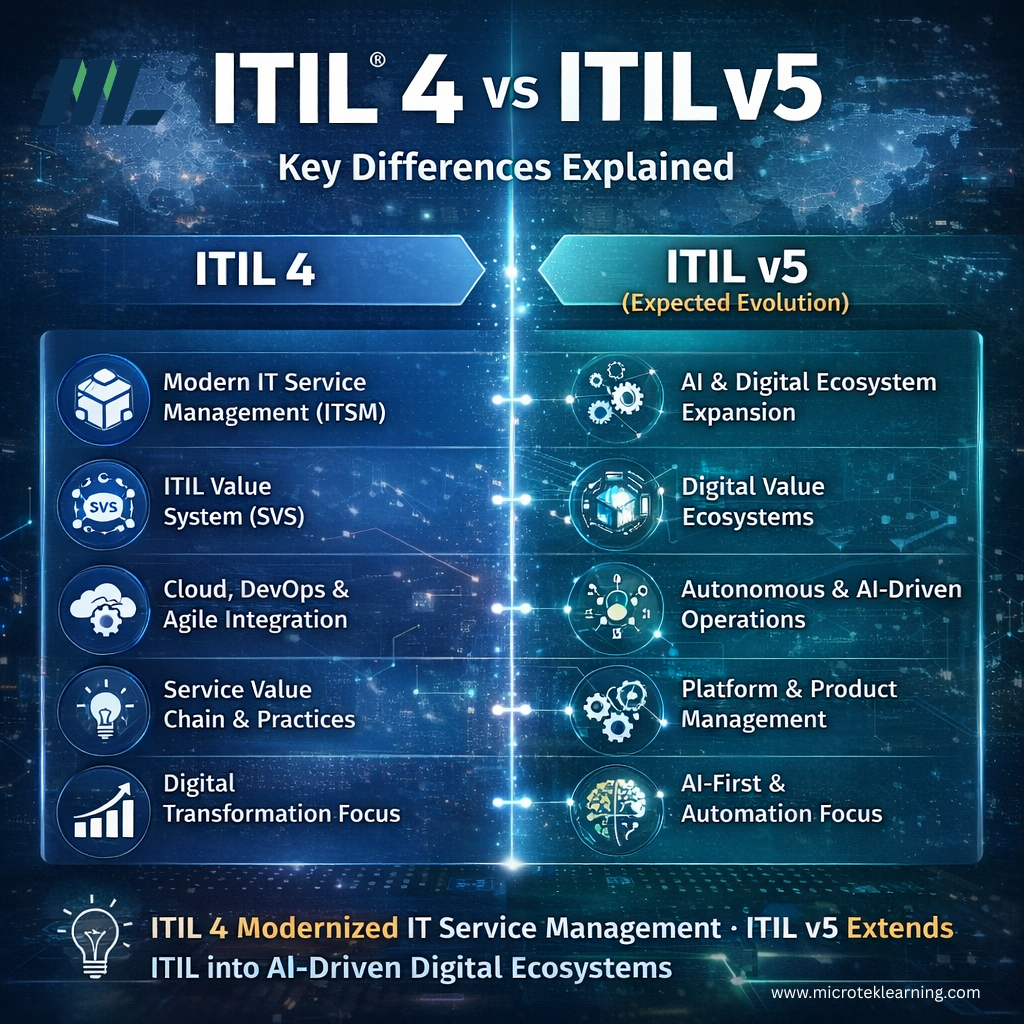
ITIL v5 vs ITIL 4: Detailed Comparison
| Category | ITIL 4 | ITIL v5 (Expected Evolution) |
|---|---|---|
| Release Timeline | Released in 2019 as the successor to ITIL v3 | Expected future evolution of ITIL focusing on digital ecosystems |
| Core Focus | Modern IT Service Management (ITSM) aligned with Agile, DevOps, and Lean | Expanded focus on digital product & service ecosystems |
| Service Management Approach | Value-driven service management through the Service Value System | Value creation across digital platforms, automation, and AI-driven services |
| Primary Framework Model | ITIL Value System (SVS) | Enhanced Digital Value Network / Ecosystem model |
| Service Delivery Model | Service value chain with six key activities | Product-oriented and platform-based service delivery |
| ITIL Practices | 34 management practices replacing processes from ITIL v3 | Expected expansion to include AI, automation, and digital governance practices |
| Service Lifecycle | Replaced the strict lifecycle with value streams | Combines lifecycle thinking with continuous product delivery models |
| Digital Product Management | Introduced but not a core focus | Expected to be a central element of IT service strategy |
| Integration with Agile & DevOps | Strong integration with Agile, Lean, and DevOps methodologies | Deeper integration with platform engineering and DevOps automation |
| Automation & AI | Recognized but not deeply embedded | Designed for AI-enabled IT environments and intelligent automation |
| Continual Improvement Model | Built-in continual improvement practice across the framework | Expanded to include data-driven optimization and predictive improvements |
| Customer Experience | Focus on value co-creation with customers | Focus on experience management and digital service ecosystems |
| Operational Technology Support | Primarily focused on IT services | Expanded support for IoT, AI, and digital infrastructure services |
| Governance Model | Governance integrated within the ITIL Value System | Expected stronger governance for AI systems and digital platforms |
| Technology Orientation | Supports cloud, DevOps, and modern IT operations | Designed for AI, machine learning, and autonomous IT operations |
| Organizational Structure | Encourages cross-functional service teams | Supports product teams and platform engineering models |
| Data Utilization | Encourages analytics for service improvement | Heavy focus on data-driven service management and predictive analytics |
| Certification Structure | Foundation → Managing Professional → Strategic Leader → Master | Expected certification updates emphasizing AI-enabled service management |
| Business Alignment | Aligns IT services with business objectives | Aligns digital products, services, and customer experiences with business strategy |
| Future Readiness | Built for digital transformation | Designed for AI-first organizations and autonomous IT operations |
Core Principles Behind ITIL v5
The ITIL framework has always emphasized delivering value through structured service management practices. The expected principles of ITIL v5 will continue this focus while expanding into digital service ecosystems.
Key principles include:
1. Value-Centered Service Management
ITIL v5 focuses on delivering measurable value through services rather than simply managing IT infrastructure.
2. Integration with Digital Product Management
Modern organizations treat technology capabilities as products. ITIL v5 supports Digital Product Management practices, allowing IT teams to collaborate more effectively with product teams.
3. Data-Driven Decision Making
The framework encourages organizations to use analytics, automation, and AI to improve service performance.
4. Continuous Optimization
The principle of Continual Improvement remains central to ITIL practices, helping organizations refine processes and enhance service quality over time.
The ITIL Value System in ITIL v5
One of the most important concepts within the framework is the ITIL Value System.
The ITIL Value System defines how all components and activities of an organization work together to facilitate value creation through IT-enabled services.
It typically includes:
- Guiding principles
- Governance
- Service value chain
- Practices
- Continual improvement
In ITIL v5, the value system is expected to evolve further to support modern AI-enabled IT environments, ensuring services are designed, delivered, and improved efficiently.
Service Lifecycle and Modern IT Operations
Earlier ITIL versions introduced the concept of the Service Lifecycle, which structured services into phases such as:
- Service strategy
- Service design
- Service transition
- Service operation
- Continual improvement
While newer frameworks focus more on value streams and agile delivery models, the Service Lifecycle concept still provides the foundational structure for managing services effectively.
ITIL v5 continues to emphasize lifecycle thinking while adapting processes to support faster digital service delivery.
ITIL v5 Certification Path
One of the main reasons professionals research the framework is to pursue ITIL v5 certification.
Although certification structures may evolve, they generally follow a progressive learning path designed to help professionals build expertise in IT Service Management.
A typical certification path may include:
ITIL v5 Foundation
This entry-level certification introduces:
- ITSM fundamentals
- ITIL terminology
- Core service management concepts
- The ITIL Value System
This certification is ideal for beginners entering the IT service management field.
ITIL Intermediate or Specialist Certifications
These certifications focus on specific areas such as:
- Service design
- Service operations
- Digital service management
- Automation and AI in service delivery
They are typically designed for professionals already working in IT operations or service management roles.
ITIL Strategic Leadership or Expert Level
Advanced certifications prepare professionals for leadership roles and cover topics like:
- Digital transformation strategy
- Enterprise service management
- Advanced governance models
Professionals pursuing these certifications often work in roles such as IT managers, service delivery managers, and digital transformation leaders.
Who Should Pursue ITIL v5 Certification?
The ITIL v5 certification is valuable for professionals across many IT and business roles.
Common job roles that benefit from ITIL include:
- IT service managers
- IT support professionals
- DevOps engineers
- IT project managers
- Cloud operations specialists
- Digital transformation consultants
- Product managers working with technology teams
Even professionals outside IT operations can benefit, especially those involved in Digital Product Management or service delivery strategies.
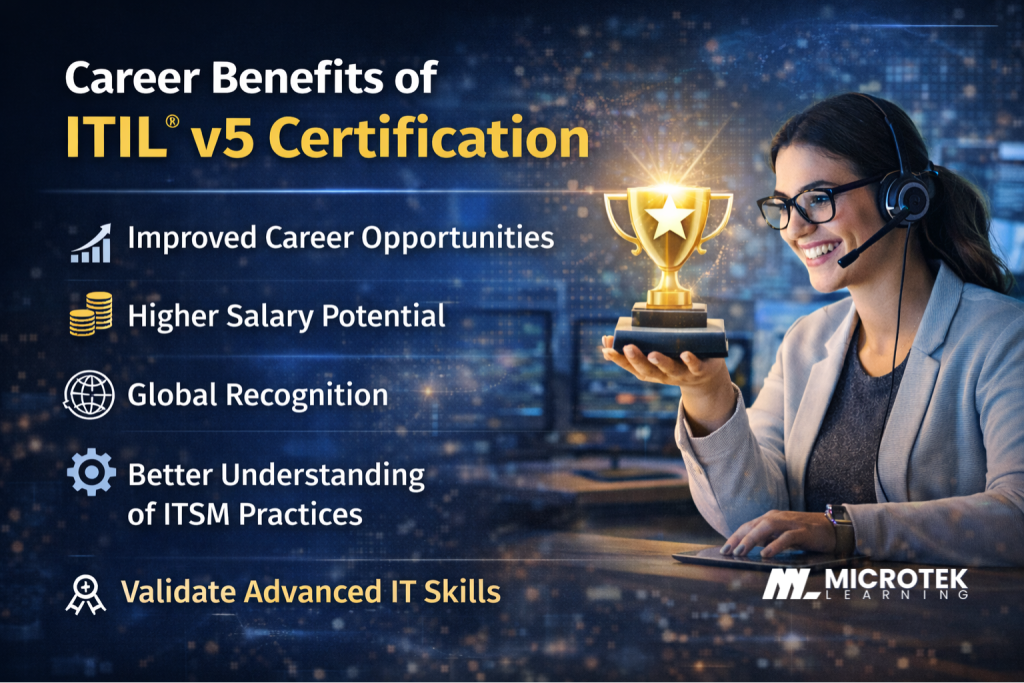
Career Benefits of ITIL v5 Certification
The demand for structured service management continues to grow as organizations rely heavily on technology services.
Benefits of ITIL certification include:
Improved Career Opportunities
Organizations worldwide use ITIL as the standard framework for managing IT services.
Higher Salary Potential
Professionals with ITIL certifications often qualify for higher-level service management roles.
Global Recognition
ITIL is recognized internationally, making the certification valuable for professionals working in global organizations.
Better Understanding of ITSM Practices
Certification provides a deep understanding of IT Service Management (ITSM) processes, governance models, and best practices.
Career Opportunities After ITIL v5 Certification
Include roles like:
- IT Service Manager
- Service Delivery Manager
- IT Operations Manager
- ITSM Consultant
- Digital Service Manager
How ITIL v5 Supports AI-Enabled IT Environments
Modern organizations are increasingly integrating artificial intelligence into their service management systems.
ITIL v5 supports these environments by encouraging:
- Intelligent incident management
- Predictive analytics for service performance
- Automated service workflows
- AI-driven monitoring and diagnostics
This allows IT teams to move from reactive support models to proactive service management.
Preparing for ITIL v5 Certification
Preparing for ITIL certification typically involves structured learning combined with practical understanding.
Steps to prepare include:
Understand ITSM Fundamentals
Before pursuing certification, it is important to understand basic IT service management principles.
Enroll in Structured Training
Professional training programs provide guided learning, practice exams, and instructor-led insights.
Study Official Framework Concepts
Focus on understanding concepts like:
- The ITIL Value System
- Service value chains
- Service lifecycle models
- Continual improvement practices
Practice Exam Questions
Practice tests help candidates understand exam structure and reinforce key concepts.
To build a strong understanding of IT Service Management concepts, many professionals enroll in structured ITIL v5 certification training programs that provide hands-on learning and exam preparation.
Why Organizations Adopt ITIL Frameworks
Organizations implement ITIL practices for several strategic reasons.
These include:
- Improving service reliability
- Aligning IT services with business goals
- Enhancing customer satisfaction
- Reducing operational risks
- Supporting digital transformation initiatives
The ITIL framework helps create a structured and scalable approach to service delivery across departments.
Why Choose Microtek Learning for ITIL Training
When preparing for ITIL v5 certification, choosing the right training provider is essential.
Microtek Learning offers professional training designed to help learners build practical knowledge of IT Service Management frameworks.
Key benefits include:
- Expert instructors with real-world ITSM experience
- Flexible training schedules
- Hands-on learning approach
- Comprehensive exam preparation support
Whether you are beginning your IT service management career or advancing into leadership roles, structured training can significantly improve your learning experience.
Final Thoughts
The ITIL v5 certification represents the next step in the evolution of IT service management frameworks. As organizations continue adopting digital platforms, automation, and AI-driven technologies, structured service management practices will become even more important.
By combining IT Service Management (ITSM) best practices, the ITIL Value System, Digital Product Management principles, and Continual Improvement strategies, ITIL v5 aims to help organizations deliver reliable, value-driven services in modern digital environments.
For professionals looking to stay competitive in the IT industry, learning the ITIL framework and pursuing certification can be a valuable investment in long-term career growth.
FAQ’s
ITIL v5 certification validates knowledge of modern IT Service Management practices including the ITIL Value System, service lifecycle management, and digital service strategies.
Yes. ITIL certification helps IT professionals improve service management capabilities and qualify for roles in IT operations, service delivery, and digital transformation.
IT professionals, IT managers, DevOps engineers, and service managers who want to improve IT service delivery.
Most professionals prepare for the ITIL Foundation certification within 2–6 weeks depending on their experience with IT service management.