


Did you know 90% of professionals who have completed their ITIL certification have average salary of exceeding $98,000?
Working in IT industry means staying relevant and continuous learning. With changing times and technology this career path demands you to keep up with the pace of this dynamic industry by upgrading your skill set. Thus, ITIL is one of the upskilled program that can boost your current position and help you achieve excellence.
In this blog we will explore what ITIL is and how investing in this certification will help individual to land their dream jobs and ultimately get a hike in their salary.
What is ITIL?
ITIL stands for Information Technology Infrastructure Library. It is a globally recognized framework for providing It services like strategic management, access management and portfolio management. ITIL was introduced by Central Computing and Telecommunications Agency (CCTA), its primary objective of helping businesses with IT services has been in the industry since late 1980’s. AXELOS a joint venture behind this framework is known for contributing in enhanced communication practices and are world’s most respected provider. Until now they have unlocked potential outcomes by testing their guided work in more than 200 countries and 23 languages.
With its purpose of aligning IT services with consumer needs, this framework invokes the best out of the existing requirements. There are 4 versions of this framework, ITIL, ITIL v2, ITIL v3, ITIL 4. These versions over the time have expanded their contribution in the industry and have helped in achieving business goals. With this let’s dive deep into knowing more about this framework and how getting certified in it will help your IT career.
ITIL: A framework to success
IT infrastructure library’s sole purpose is to give you solutions to easily collaborate with service management and business. While communicating with the IT department, this framework helps you to find formalized processes that build working cycles and further contribute immensely to completing tasks on time. While it has evolved so much in history, this framework has different parts that serve as a bridge between your goals and the procedure needed to implement it. Hence, let’s start with ITIL service operations.
ITIL Service Operations
While entering a project timeline, several factors must be determined and taken into consideration before allotting the task. Challenges can occur while keeping a stable view of both cost and quality, and one might need to align the goals with the right set of information.
ITIL on this side provides five process and four functions that will help you to inculcate the right set of information and implement effectively. Given below is an elaboration of both.
Four functions of ITIL are:
- Service Desk
- Technical Management
- Application Management
- IT Operation Management
Five processes of ITIL are:
- Event Management
- Access Management
- Request Fulfilment
- Problem Management
- Incident Management
ITIL Seven Guiding Principles
ITIL works on these 7 principles projecting its core message for service management. Tailored according to organization as they work and adapt these principles help the team to be more specific and customize the process to their specific needs. These principles are universal and can work for any business needs regardless of their aim and type of execution.
- Focus on value
- Start where you are
- Progress with feedback
- Collaborate and promote visibility
- Think and work
- Keep it simple
- Optimize and automate
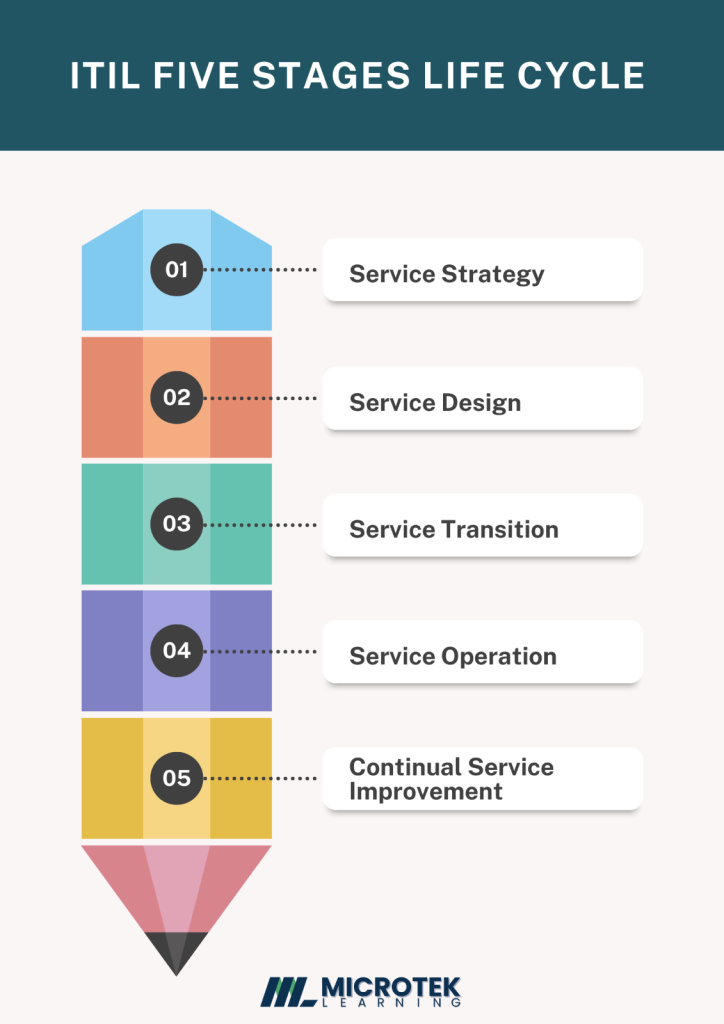
ITIL Five Stages Lifecycle
The ITIL Five Stages Lifecycle is an outline of the life cycle with the primary aim of highlighting the importance of being coordinated during different procedures. The cycle deals with different processes and systems for managing IT services. It is based on ITIL v3, which is prior to ITIL v4. Let’s learn more about the five stages:
ITIL Certifications
Now that we are aware of how ITIL brings out major differences in the most positive way in any organization or individual professional career, one should know what are ITIL certification and which course to take and how it will impact one’s current position. ITIL 4, the most advanced version, has multiple levels that can be achieved. These are given below:
- Foundational: ITIL 4 foundational certification is an entry-level certification for beginners. This certification focuses on providing a deep understanding of the upgraded versions of ITIL and makes one aware of the basics of the framework. There are several key concepts that are covered in this part of the certification, like understanding the four dimensions of service management and SVC (service value chain)
- Exam Format: Multiple Choice Questions (MCQ)
- No. of Questions: 40
- Exam Duration: 60 minutes
- Passing Score: 26 out of 40, that makes it 65%
- ITIL Managing Professional (MP): This level of certification helps managers to have a clear command view of their teams. While gaining knowledge on supervising digital teams and projects.
- Exam Format: Multiple Choice Questions (MCQ)
- No. of Questions: 40
- Exam Duration: 90 minutes
- Passing Score: 28 out of 40, that makes it 70%
- ITIL Strategic Leader (SL): This level of certification enables professional to draw a clear picture on how IT influences business roles and strategy while focusing on improvement of the existing pathways. To become certified in ITIL strategic leader, one should have completed their certification in ITIL 4 foundation. One should also have completed two more modules names ITIL 4 strategist and ITIL 4 leader.
- Exam Format: Multiple Choice Questions (MCQ)
- No. of Questions: 30
- Exam Duration: 60 minutes
- Passing Score: 21 out of 30, that makes it 70%
- ITIL Practice Manager: This level of certification has primary focus on good-practice collaboration. Giving specialized knowledge, this module deals with planning, controlling, implementing, and monitoring.
- Exam Format: Multiple Choice Questions (MCQ)
- No. of Questions: 40
- Exam Duration: 90 minutes
- Passing Score: 28 out of 40, that makes it 70%
- ITIL Master: This is the highest level of certification available in ITIL. This can be earned after completing all the previous levels. Achieving this level helps you to be recognized as a professional who have deep understanding of the framework and can further practically handle collaboration between the process and IT services.
ITIL Benefits
Growing digital challenges is making consumer service complex and tough. ITIL framework is an answer to collaborating on the project analysis. Equipped with best practices for developing and managing the environment and services, ITIL majorly contributes to finding a balance between process and communication. Gaining certification in ITIL has various advantages for both organizations and professionals. Let’s elaborate on both categories to understand more.
Individual Professional Benefits
- Increased Earning Potential: ITIL being globally recognized as best practice is high in demand. Professionals with ITIL certification is have the right knowledge to handle projects practically and adds value to the team. Being qualified can lead to landing positions with higher salary.
- Showcases Your Commitment: Completing certification in ITIL makes an individual aware of the needed skillset and showcases his commitment to the dynamically changing IT industry.
- Enhance Your Skills: ITIL certification have various levels of certification according to your needs and position in the industry. Completing this certification shows your deep understanding of the subject and helps you to boost confidence by accomplishing mastery in the domain.
- Salary Opportunities: Becoming an expert in ITIL framework helps you to solve problems with expertise and gives you an upper hand in getting selected by top companies.
- Credibility and Productivity: ITIL framework help you to enhance the project work form by improved communication and further training you to become a solution oriented professional.
Organizational Benefits
- Efficient use of assets and services
- Informed decision-making with effective outcomes
- Regulate a disciplined framework with accurate results
- No wastage of resources and assets
- Increased productivity
- Effective communication
- Improved client services, resulting in satisfaction
Conclusion
ITIL framework is not just a certification; it is key to uplift your career and bring an efficient advantage to your organization. With expertise in this certification, one can provide enhanced service delivery. Hence, whether you are an individual at the beginning of your career or an organization looking to upskill your dynamic team, this certification will help you master skills that will boost your career.
Now that you know everything about ITIL certification path and are ready to bridge the gap between operational excellence and technology Microtek Learning can prove to be your perfect partner to meet your career goals.
Our guided sessions, assessments and practice papers will help you understand deep concepts and further guide you to be an expert yourself. Start your upskilling journey with us today!
FAQ
What is the ITIL framework?
ITIL framework refers to a set of practices brought together to effectively collaborate and communicate with teams. Managing every step throughout the process, this framework guides the best in achieving deadlines and desired outcomes.
What is ITIL certification?
ITIL certification provides professional expertise in managing IT services. Its primary focus is to standardize various processes and smooth multiple stages into quality results.
Who is eligible for ITIL certification?
ITIL 4 is an entry-level certification that requires no prior experience. The only criteria required is to have basic knowledge about the IT industry to apply the learnings.
What are the five stages of ITIL?
The five stages of ITIL are:
- Service Strategy
- Service Design
- Service Transition
- Service Operation
- Continual Service Improvement
Is ITIL certification worth it?
Completion of ITIL certification offers professionals new positions and a hike in their current salary. Aiming for this certification can be a crucial step in your career growth.
How much does ITIL certification cost?
On average, an ITIL certification can range between $300 and $400 USD.